“The formation of new blood vessels is not a mere physical process but an energy-driven phenomenon, where proteins guide water flows, creating structure in precise alignment with the energetic needs of the body.” — Wu & Sun
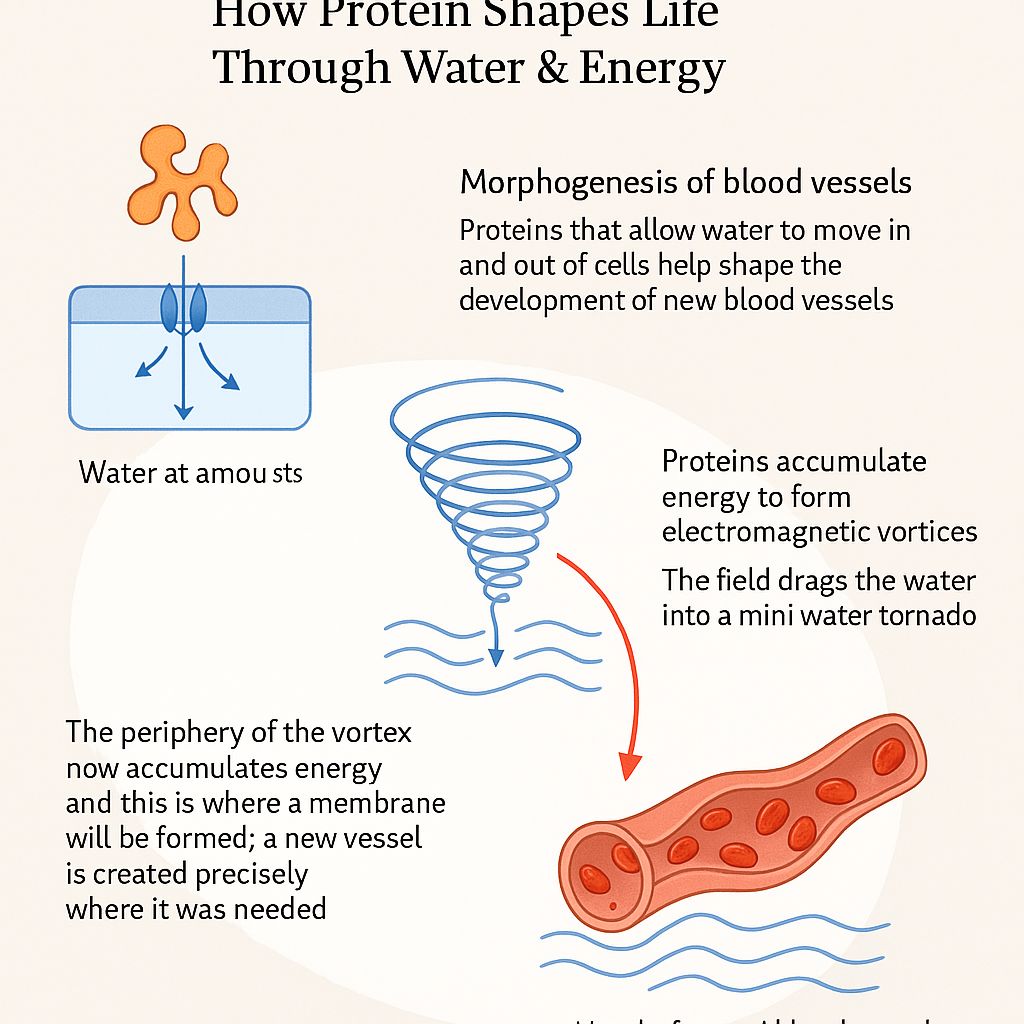
Electromagnetic Field + Protein = Morphogenesis
Structure follows energy flow
Specific proteins (like aquaporins) guide water movement, creating structural flows. These flows, under energy accumulation (like an EMF vortex), can organize physical structures—such as forming new blood vessels.
Vortex-based motion in water is increasingly recognized in embryogenesis, tissue regeneration, and capillary growth.
In the dance of life, proteins are far more than mere building blocks. They are the orchestrators of transformation, the quiet architects of every structure in our body, from our muscles to our bones to the very vessels that carry life’s blood.
But what if proteins also have a role in shaping energy itself?
The Role of Proteins in Our Bodies
Proteins, made of amino acids, are often thought of as the body’s scaffolding. We eat them to repair, rebuild, and renew. But they’re not just static components. These amino acids create vibrational fields, guiding water, shaping structures, and channeling energy. They form the bridges between the material and energetic realms.
In the body, proteins help shape blood vessels—and here’s where things get fascinating.
Water, Energy, and the Formation of New Blood Vessels
In a remarkable discovery, scientists Wu and Sun unveiled a phenomenon: proteins in the body direct water flow, harnessing energy to create miniature vortices—like tiny tornadoes in our cells. These vortices guide water into the spaces where it’s needed most, pulling in blood cells and building new vessels with precision. This process, called morphogenesis, is one of nature’s most elegant designs.
It’s not just about the material of the blood vessel but how the energy flows to create it. This process aligns perfectly with the understanding that structure follows energy—a principle embedded in both ancient wisdom and modern physics.
Aging, Vascular Health, and the Need for Protein
As we age, the body’s ability to repair itself slows down. The scaffolding weakens, and the energy flow becomes less efficient. Our blood vessels lose their elasticity, and tissues regenerate more slowly. In this time of slowed regeneration, we need more protein, not less. Yet, many believe the opposite—that we should reduce protein intake as we age to avoid conditions like gout or acidity.
This is where modern biology and ancestral wisdom converge: protein is needed to maintain healthy tissue, support blood flow, and, yes, even to keep the electromagnetic flow of energy in our bodies vibrant. The amino acids from protein don’t just form the vessels—they enable them to function harmoniously, supporting life’s rhythm.
The Myth of Low-Protein Diets
In a world that often gravitates toward low-protein diets for fear of acidity or kidney damage, we’re overlooking one crucial factor: without adequate protein, the body lacks the materials and energy structures needed to thrive. This is especially true when it comes to vascular health—the foundation of youth, vitality, and energy. Without the proteins to support this energetic architecture, we begin to lose more than just our tissues; we lose the very flow of energy that sustains life.
Living in Harmony with Protein’s Purpose
As you age, think of protein not just as a fuel source but as a life force, one that is woven into the intricate dance of water, energy, and creation. By respecting the need for protein, you enable your body’s natural regenerative abilities to flow freely. Just like the tiny vortices formed by water and proteins, your body needs these building blocks to keep its energy flowing, to regenerate tissues, and to stay vibrant.
In the end, life is more than a series of chemical reactions. It’s a symphony of energy, with proteins acting as the conductors—guiding the flow, shaping the vessels, and creating the harmony that sustains us.
Discover more from Feel Good Counselling
Subscribe to get the latest posts sent to your email.
