What Is Creatine?
Creatine is a naturally occurring compound that plays a crucial role in the production of ATP, the primary energy currency of the cell. It is stored mainly in skeletal muscle and used during short bursts of high-intensity activity. While it exists in meat and fish, the powdered form sold as a supplement is entirely synthetic, created through industrial chemical reactions.
How Is Synthetic Creatine Made?
Unlike what many consumers believe, creatine supplements do not come from food or fermentation. They are made through a lab-based chemical process involving the reaction of sodium sarcosinate and cyanamide:
Chemical Inputs:
Sodium Sarcosinate (C₃H₆NO₂Na):
A surfactant derived from sarcosine, which is produced using petrochemical processes. Normally used in soaps and personal care products.
Cyanamide (CH₂N₂):
A synthetic, toxic chemical used in fertilizers and pharmaceuticals. Known to interfere with DNA and cellular respiration at high or sustained doses.
These chemicals are reacted under high heat and pressure. Solvents such as methanol or ethanol may be used to purify the final compound before it is dried into the familiar white powder known as creatine monohydrate.
This process is entirely man-made, involving no natural food inputs. It is not a fermentation, not derived from animals, and lacks the cofactors that come with whole food nutrition.
Sources:
Is Creatine Found in the Human Body Naturally?
Yes. The human body makes about 1 gram of creatine per day, primarily in the liver, pancreas, and kidneys, using the amino acids arginine, glycine, and methionine. Even individuals who do not consume meat or fish will still produce creatine endogenously, although their muscle stores may be lower compared to omnivores.
This natural production supports the body’s energy needs but may not saturate muscles to the same extent as dietary sources or supplementation.
Source:
PMC7246861 – Creatine metabolism on vegan diets
Why Do Muscles Look “Pumped” After Taking Creatine?
One of the most noticeable effects of creatine supplementation is the swollen or pumped look in muscles. This happens because creatine draws water into the muscle cells, causing intracellular water retention, a mild form of edema within the muscle tissue.
This kind of water retention increases the pressure inside the muscle, making it appear larger and fuller, not necessarily due to real muscle growth, but due to fluid accumulation. While some see this as a visual benefit, it can also create imbalances if the body is not fully hydrated or if kidneys are under stress.
There is some evidence suggesting this internal pressure might stimulate muscle protein synthesis, but the primary initial effect is simply water shifting into muscle cells, not structural muscle change.
When Water Retention Might Be Inflammatory
For some, especially those with sluggish detox pathways, gut issues, or electrolyte imbalances, creatine might cause a bit more than muscle fullness. You might notice:
Puffiness in hands, face, or ankles
A bloated feeling
Mild swelling that isn’t limited to muscles
This could be the body’s response to systemic inflammation, possibly triggered by:
Electrolyte shifts (creatine influences sodium-potassium balance)
Low-grade immune responses, especially if the gut lining is compromised
Why the Body Retains Water
Your body is smart. It holds onto water to:
Dilute excess solutes in the blood
Protect tissues if it senses irritation
Maintain cellular balance during osmotic shifts
Sometimes, this can look and feel like edema, especially if the lymphatic system is sluggish or there’s underlying inflammation
Source:
PMC8949037 – Creatine impact
How Does Synthetic Creatine Compare to Creatine in Meat and Fish?
1. Source:
Meat/Fish: Creatine occurs naturally in muscle tissue of animals such as beef, herring, salmon, and other fish.
Synthetic Supplement: Manufactured in a lab through a chemical reaction between cyanamide and sodium sarcosinate, both industrial chemicals.
2. Nutrient Profile:
Meat/Fish: Contains creatine alongside essential co-nutrients like iron, vitamin B12, zinc, carnitine, taurine, CoQ10, and omega fats.
Synthetic Supplement: Contains only isolated creatine, devoid of any supporting nutrients or cofactors.
3. Processing:
Meat/Fish: Minimal processing typically cooked or eaten raw (e.g. sushi). Body digests and absorbs creatine in context with proteins and fats.
Synthetic Supplement: Undergoes high-heat industrial processing, solvent purification, and crystallization.
4. Biological Synergy:
Meat/Fish: The body recognizes it as part of a complete food source; nutrients work synergistically for uptake and function.
Synthetic Supplement: Lacks food-based synergy. The body processes it as an isolated compound, possibly placing more stress on elimination organs.
5. Safety Profile:
Meat/Fish: Historically consumed by humans, well-tolerated, nutrient-dense.
Synthetic Supplement: Potential for chemical residues, untested long-term effects in high doses, and more likely to cause side effects such as bloating or kidney stress.
6. Absorption & Function:
Meat/Fish: Delivered within a matrix of proteins, peptides, and fats that may support natural absorption and metabolism.
Synthetic Supplement: High concentrations can overwhelm pathways or alter osmotic balance, leading to water retention (edema) in muscle tissue.
Health Risks, Side Effects & Contraindications
Even in purified form, synthetic creatine can carry risks, especially when consumed over time or in combination with other stressors:
Potential Risks:
- Kidney stress with high doses or in individuals with compromised renal function
- Water retention, bloating, or cramping
- Impaired gut microbiome due to unbuffered amino acid influx
- Potential chemical residue exposure (from synthesis)
- Unknown long-term effects on liver, detox pathways, and endocrine system
- increases methylation demand (SAMe usage), which matters more with age and thyroid sensitivity
- Cancer Cell Metabolism
- Cancer Cell Metabolism 2
- Cancer Cell Metabolism 3
- Cancer cells use energy molecules like Creatine, Glucose etc to grow and spread. Excess creatine above what your body needs promotes cancer growth.
Contraindications:
- Pre-existing kidney or liver disease
- Thyroid disorders (due to cyanamide toxicity concerns)
- Alcohol users (cyanamide causes disulfiram-like reactions)
- Pregnancy or breastfeeding (lack of safety data)
- Anyone with chemical sensitivities or synthetic additive intolerance
What Is a Tolerable Safe Dosage of Creatine?
While mainstream health figures often promote creatine as universally safe, the context matters especially if you value whole food nutrition and minimal synthetic exposure.
The body naturally makes about 1 gram of creatine daily, and omnivorous diets typically provide an additional 1–2 grams from meat and fish.
Tolerable Safe Supplement Dose
For those who choose to supplement despite the synthetic origins a low, tolerable dose would stay close to what the body and nature already provide:
1–3 grams per day (maintenance dose)
This range mimics natural intake without overloading the kidneys or dramatically shifting cellular hydration balance. It’s generally well tolerated by most healthy individuals.
Caution with Loading Phases
Many commercial recommendations suggest a loading phase of 20g/day (in divided doses) for the first 5–7 days, followed by a 5g/day maintenance dose. However:
- This approach may stress the kidneys
- Dramatically shifts water balance
- Exceeds what the body is adapted to handle naturally
- Comes with a higher toxic load from the synthetic manufacturing process
Upper Limit (Not Advisable Long-Term)
While clinical studies sometimes use up to 5 grams per day long-term, this should be considered the upper tolerable limit for healthy individuals:
Not recommended for people with liver, kidney, thyroid, or detox issues
Not advised for long-term daily use without breaks
Bottom Line:
If you’re going to use creatine:
- Choose the purest form (Creapure® or other verified monohydrate brands with no additives)
- Keep the dose low (1–3g/day)
- Take occasional breaks
- Prioritize hydration, electrolyte balance, and kidney support
- Consider rotating with natural creatine-rich foods like herring, beef, and lamb
If you’re already getting enough from a nutrient-dense, ancestral diet, your body may not need extra and certainly not from petrochemical origins.
Final Thought: A Choice Between Whole Food and Industrial Chemistry
While creatine does enhance energy metabolism and has some clinical backing, it’s critical to understand what you’re really taking: a powder created from toxic synthetic precursors not found in food, altered through petrochemical and solvent-based reactions, and isolated from any natural nutrient matrix.
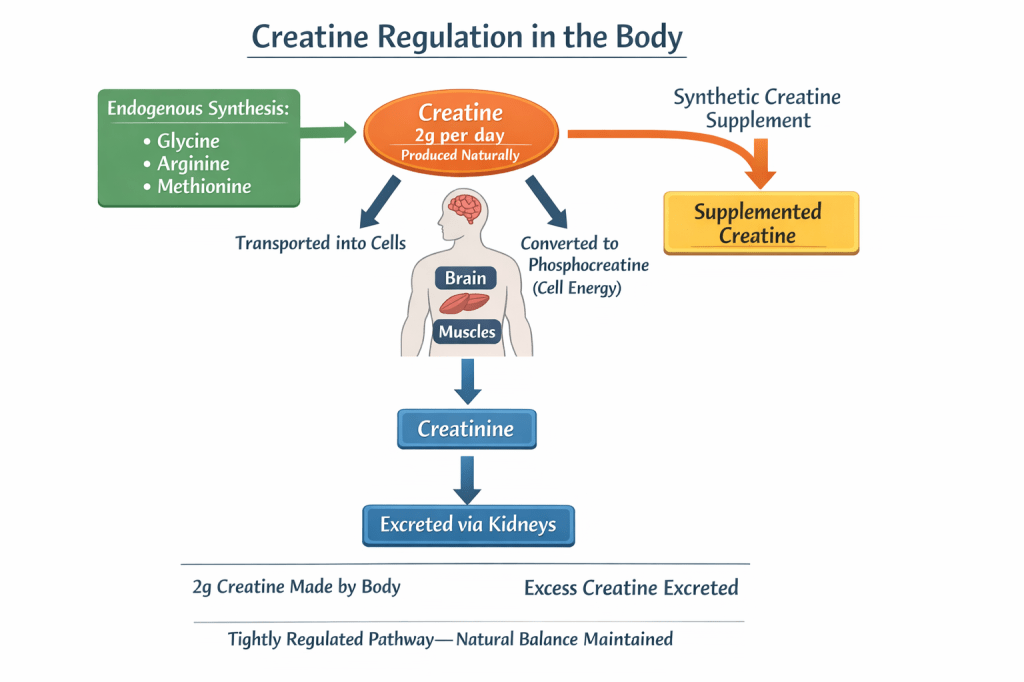
The body has a tightly controlled creatine system:
Makes ~2 g/day from glycine, arginine, and methionine (endogenous synthesis)
Regulates uptake into muscles, brain, and other tissues via transporters
Excretes excess as creatinine, keeping levels stable
Why the body wouldn’t “prefer” synthetic creatine:
Introducing large doses of an isolated compound doesn’t override this regulation — it mostly just increases excretion. Cells are tuned to maintain homeostasis; they won’t necessarily store extra or reroute energy pathways for a synthetic supplement. Any temporary rise may affect phosphocreatine pools in muscle/brain, but it doesn’t fundamentally change the DOA (de novo synthesis and metabolic) pathway. So, mechanistically, adding isolated creatine doesn’t reprogram the system — it just floods a pathway that the body already tightly controls.
In contrast, whole-food sources of creatine come with cofactors, amino acids, and minerals, allowing the body to integrate it naturally into metabolism without bypassing regulation.
Discover more from Feel Good Counselling
Subscribe to get the latest posts sent to your email.
