Jonathan Eisen, PhD (Microbiologist, UC Davis):
“We do not yet know what the ‘ideal’ human microbiome is.”
David Relman, MD (Microbiome Researcher, Stanford University):
“A universal definition of a ‘healthy microbiome’ remains elusive.”
Over the past decade, the gut microbiome has become a buzzword in health circles — linked to everything from mood to metabolism. We’re told to “balance” our microbiome, that there are “good” and “bad” bacteria, and that probiotics are the answer. But what if this narrative is based on a flawed understanding of how life actually works inside us?
Let’s dig deeper.
Has the Microbiome Ever Been Clearly Defined?
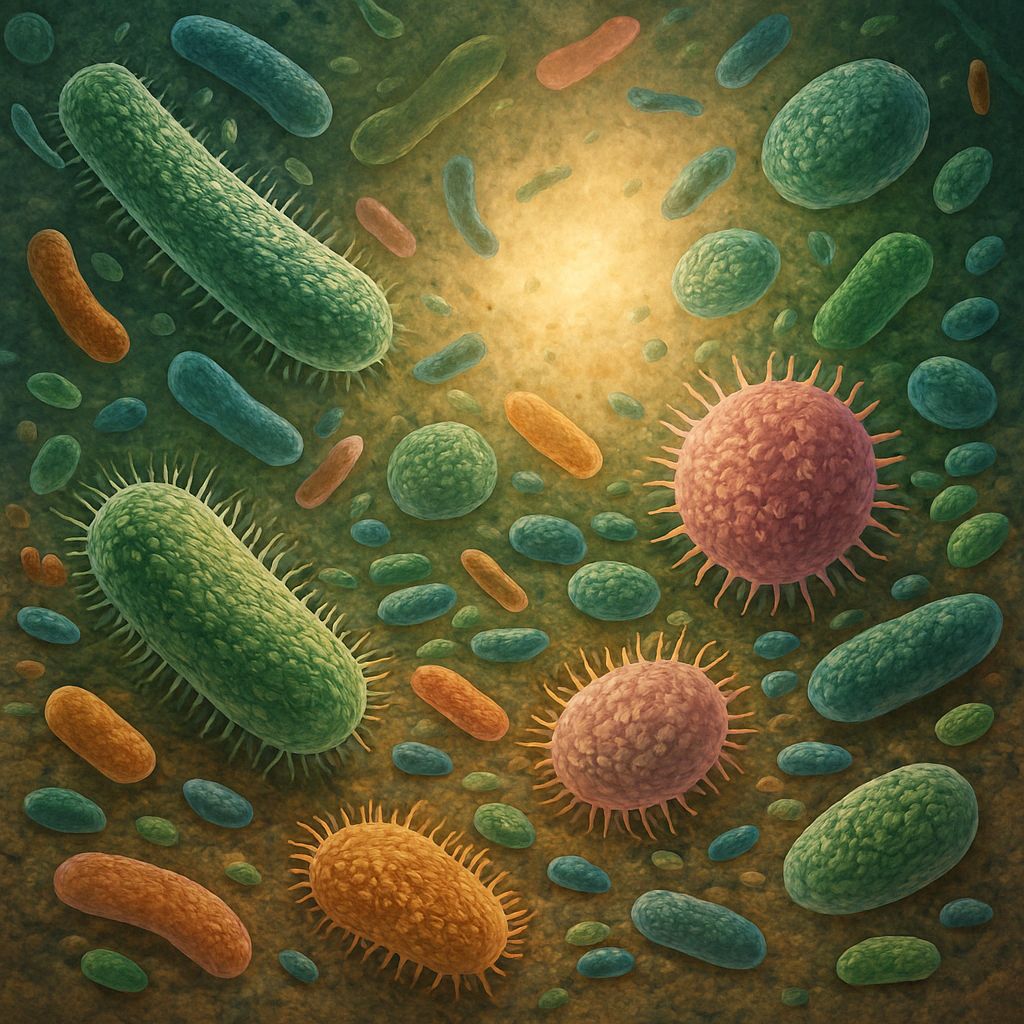
Despite all the hype, there’s no universally agreed-upon definition of what a “healthy” microbiome is. Scientific studies are often contradictory, and what’s considered “balanced” in one person may be completely different in another. Even within the same individual, microbial populations shift rapidly with changes in stress, food, sleep, and environment — sometimes within hours.
So if we can’t define what a healthy microbiome actually is, how can we claim it’s “out of balance”?
The Good vs. Bad Bacteria Myth
Thomas Cowan, MD:
“The concept of the microbiome is flawed because it assumes the identity of microbes as fixed, rather than responsive to the environment.”
Dr. Robert O. Young:
“The focus on good and bad bacteria ignores the fundamental importance of maintaining the proper pH and internal environment.”
The conventional narrative separates microbes into helpful allies or dangerous pathogens. But this duality crumbles when you examine the concept of pleomorphism — the idea that microbes are not static entities but can change form based on their environment. In this view, bacteria aren’t inherently good or bad; they morph to serve a purpose, often as part of your body’s intelligent response to internal conditions.
From this perspective, a “bad bacteria” isn’t invading you — it’s a byproduct or adaptive expression of your body’s own terrain.
Terrain Theory Revisited
This echoes the foundations of terrain theory, which emphasizes the internal environment over the microbe itself. It’s not about fighting off germs or correcting microbial imbalances — it’s about supporting the body’s innate intelligence, which already knows how to regulate and transform what it needs.
Claude Bernard:
“The terrain is everything; the germ is nothing.”
Antoine Béchamp:
“The primary cause of disease is in us, always in us.”
“Nothing is the prey of death; everything is the prey of life.”
So What About Probiotics?
If pleomorphism holds true, then the billions we spend on probiotics may be missing the point. You don’t need to ingest specific strains to “seed” your gut — you need to create the right terrain. Real food, fresh air, natural light, low stress, and inner coherence — this is what supports microbial harmony.
Dr. Stefan Lanka (Virologist):
“Microbes are not attackers — they are created by the body to dissolve substances and aid healing.”
A More Intelligent Approach
Rather than obsessing over bacterial ratios, perhaps it’s time to trust the body’s intelligence. Microbes aren’t foreign invaders to control. They’re collaborators, responders, and transformers — shaped by the internal messages we send through diet, thoughts, environment, and energy.
Dr. Zach Bush:
“You are not a host for bacteria; you are the result of a community of life expressing itself in harmony with its environment.”
When the terrain is right, the rest takes care of itself.
All References (Complete List)
1. Eisen, J. A. (2014). The Microbiome: Empirical and Conceptual Issues.
UC Davis Research Papers.
2. Relman, D. A. (2012). The human microbiome: ecosystem resilience and health. Nutrition Reviews, 70(Suppl 1), S2–S9.
3. Béchamp, A. (1912). The Blood and Its Third Anatomical Element.
Paris: Librairie Germer Baillière.
4. Bernard, C. (1865). An Introduction to the Study of Experimental Medicine.
5. Young, R. O. (2015). Sick and Tired: Reclaim Your Inner Terrain. Woodland Publishing.
6. Cowan, T. (2020). The Contagion Myth: Why Viruses (including “Coronavirus”) Are Not the Cause of Disease.
7. Lanka, S. (2001). The Misconception Called Virus. Interview and essay archives.
8. Bush, Z. (2019). Human Health in the Microbial World. Interviews, lectures, and online talks.
9. Hillman, H. (1991). The Living Cell: A New Perspective.
Croom Helm Publishing.
10. Lacaz-Vieira, F. (2020). Is there a healthy microbiome? JCI Insight.
Discover more from Feel Good Counselling
Subscribe to get the latest posts sent to your email.
