
Salt, like cholesterol, should not be feared. Just as we know that white, processed sugar can be harmful, purified white salt found in many packaged foods acts similarly in the body. This is because the body struggles to process isolated, unnatural chemical compounds.
Two Very Different Salts
1. Refined Sodium Chloride = Industrial Toxin
2. Unrefined Sea Salt = Whole Food Nutrient
The first type is what we find in ultra-processed food: bread, pasta, table salt, tinned goods. It often includes sodium-based compounds like:
Sodium nitrate/nitrite
Monosodium glutamate (MSG)
Sodium benzoate
Disodium phosphate
Baking soda (sodium bicarbonate)
These forms are not the same as the living crystal of pure sea salt or rock salt, which contains up to 82 trace minerals the body recognizes and uses wisely.
We can also get natural sodium from vegetables like celery, tomatoes, and seaweed—but most people don’t eat enough of these regularly.
Salt & Energy: We Are Electric
Real salt is involved in:
Regulating aldosterone, insulin sensitivity, and thermogenesis
Supporting digestion and stomach acid production
Maintaining fluid balance and electrical charge
Too Little Salt? You May Experience:
Low energy and sluggish metabolism
Poor nutrient absorption
Weak stomach acid
Cold intolerance
Imbalances in mood and hormones
The Sweet Spot: Not Too Little, Not Too Much
There is no exact “correct” amount of salt for everyone. Some people may need more or less based on their activity level, environment, EMF exposure, overall health, and specific biochemical makeup.
What’s most important is to balance your sodium intake with adequate potassium. Potassium helps regulate your sodium levels and supports proper hydration, muscle function, and heart health.
Sodium Sensitivity: We’re Not All the Same
Some people especially those with kidney issues, high blood pressure, or certain ancestral traits may retain more sodium, making them salt-sensitive. That doesn’t mean salt is the enemy, but it does mean quality, balance, and context matter.
Salt Needs and Environmental Influences
1. High UV Environment → Less Salt Needed
Why: In areas with high natural sunlight (UV exposure), your body:
Produces more Vitamin D3 Sulfate, which helps regulate mineral balance.
Supports healthy adrenal and electrolyte function, making salt retention more efficient.
Enhances natural hydration and sodium-potassium balance.
Effect: You may need less salt because your body is better at maintaining fluid and electrolyte balance.
2. High EMF Exposure → More Salt Needed
Why: EMFs (from Wi-Fi, mobile towers, electronics) can:
Disrupt voltage-gated calcium channels, leading to cellular stress.
Increase oxidative stress, impacting mineral and water balance.
Interfere with the electrical function of cells, especially neurons and heart cells.
Salt’s Role:
Acts as a natural conductor and buffer for bioelectrical activity.
Helps maintain electrolyte integrity and reduces EMF-related stress.
Effect: In high EMF environments (cities, modern homes), you may need more salt, especially unrefined mineral salts rich in trace elements.
3. Cold, Low-UV Regions (e.g. Scandinavia) → More Salt Needed
Why:
Lower UV means less Vitamin D3 Sulfate production and possibly slower metabolism.
Colder temperatures can blunt thirst and reduce water intake, yet the body still loses fluids through respiration and metabolism.
Diets in northern regions traditionally include more salt (e.g. salted fish, preserved meats), which supports:
Electrolyte balance in colder climates.
Energy and nerve conduction during winter months.
Effect: If you live in northern, low-UV places like Scandinavia, your body may require more salt to support mineral metabolism and hydration.
Summary
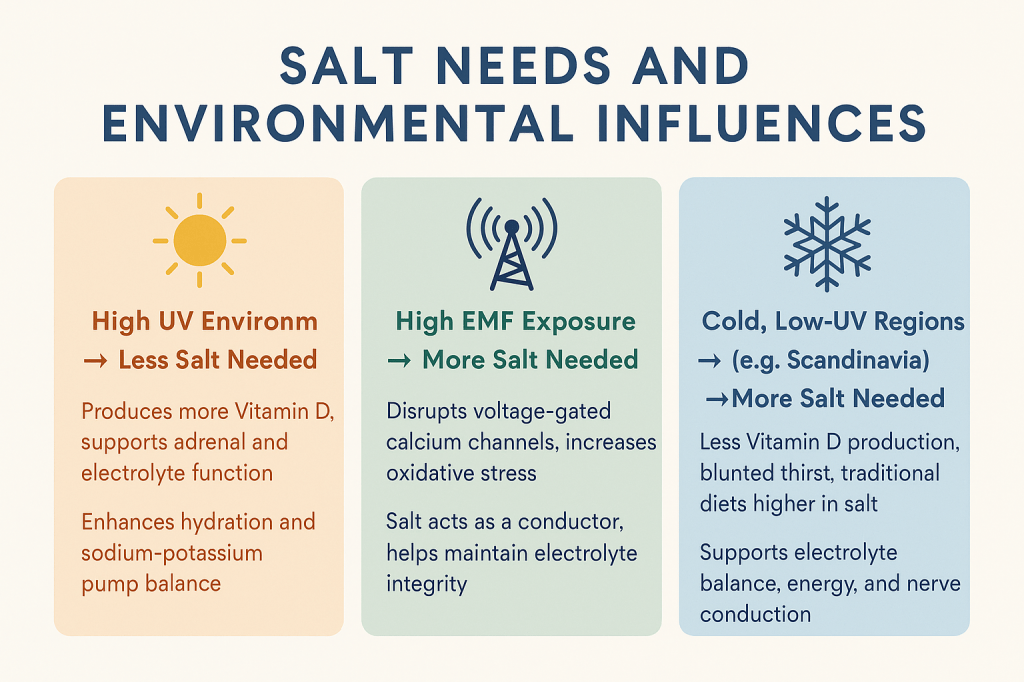
High UV (e.g. tropics) ↓ Less salt Improved mineral balance, adrenal function, and hydration
High EMF (e.g. urban areas) ↑ More salt. Salt acts as protective buffer against electrical stress.
Low UV/Cold (e.g. Scandinavia) ↑ More salt. Reduced vitamin D, slower metabolism, traditional diets higher in salt.
1. Sunlight lowers aldosterone
Aldosterone is a hormone that tells your kidneys to retain sodium.
UVB exposure reduces aldosterone, meaning your body retains less salt naturally, which can help regulate blood pressure and fluid balance in the heat.
This reduces the need for extra salt, your body is conserving it more efficiently.
2. Improved mineral regulation from sun
Sunlight boosts vitamin D, which helps regulate calcium, magnesium, and phosphate these minerals interact with sodium.
With good vitamin D levels, your electrolyte system becomes more efficient, so salt cravings may drop.
3. Less internal stress = fewer salt losses
High cortisol or chronic stress increases salt-wasting.
Sunlight (especially early morning and UV exposure) tends to lower cortisol and activate parasympathetic balance, reducing salt loss through urine.
4. Sweat composition may change
As your body adapts to sun and heat, it becomes more efficient at sweating — conserving sodium while still cooling the body.
So, even if you sweat more, you may not need to replenish as much salt as you think, your body gets better at holding on to it.
So, you might need less salt in high UV because:
You’re retaining more naturally
Your cortisol is lower
Your electrolyte regulation is sharper
And you’re more metabolically balanced
Ready to Explore Your Salt Balance and Overall Health?
Every body is unique, and finding the right balance of nutrients for yours is crucial to achieving optimal health. If you’re feeling unsure about your sodium or potassium intake, or want more guidance on aligning your diet with your personal needs, consider booking a consultation. Let’s work together to create a plan that supports your health and vitality, in harmony with Nature.
Book your consultation today at book@feelgoodcs.com
Call +34 634 35 48 92 for more information.
Discover more from Feel Good Counselling
Subscribe to get the latest posts sent to your email.
