What if cancer begins not with a genetic mutation, but with an energy crisis?
We are usually taught that cancer begins when mutations occur in a cell’s DNA. Those mutations then cause the cell to grow and divide when it shouldn’t.
But there is another way of looking at cancer.
Professor Thomas Seyfried and other researchers have drawn attention to something very fundamental about cancer cells: their energy metabolism is profoundly different from that of healthy cells.
The idea explored here goes one step further.
What if the change in metabolism is not simply something that happens after cancer develops? What if a failure in the cell’s energy-producing machinery is the event that sets the whole process in motion?
Think of it as a cellular Big Bang.
—
The cell’s power stations
Almost every cell in our body contains tiny structures called mitochondria.
They are often described as the cell’s powerhouses, although that description is rather simplistic. Their most important role is to produce energy efficiently through a process called oxidative phosphorylation, or OxPhos.
When this system is working normally, the mitochondria can extract a large amount of usable energy from nutrients.
But what happens if the mitochondria become seriously damaged or unable to respire properly?
The cell still needs energy.
It cannot simply stop making ATP, because ATP is the immediate energy currency that powers almost everything the cell does — including maintaining its membrane, controlling its internal environment and staying alive.
So the cell has to find another way.
—
The emergency energy system
One of the best-known changes in cancer metabolism is the Warburg effect.
Instead of relying primarily on mitochondrial respiration, many cancer cells consume large amounts of glucose and convert much of it into lactate, even when oxygen is available.
This is essentially a form of fermentation.
The problem is that glycolysis produces very little ATP per molecule of glucose compared with mitochondrial respiration.
So the cell has to process enormous amounts of glucose to obtain enough energy.
There is another pathway that can contribute to this emergency system: glutamine metabolism.
Glutamine can enter mitochondria and be processed through parts of the TCA cycle. One of the reactions involving succinyl-CoA can generate ATP or GTP directly through substrate-level phosphorylation (SLP).
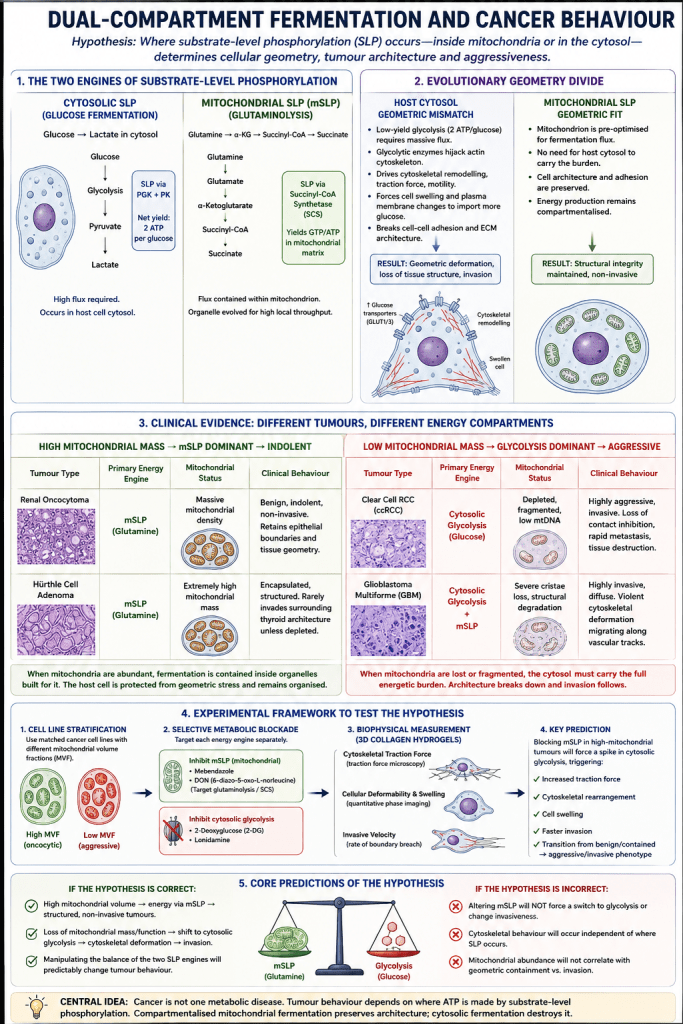
This gives us two potential sources of substrate-level energy:
Glucose → glycolysis → lactate → ATP
and
Glutamine → mitochondrial metabolism → succinyl-CoA → SLP → ATP/GTP
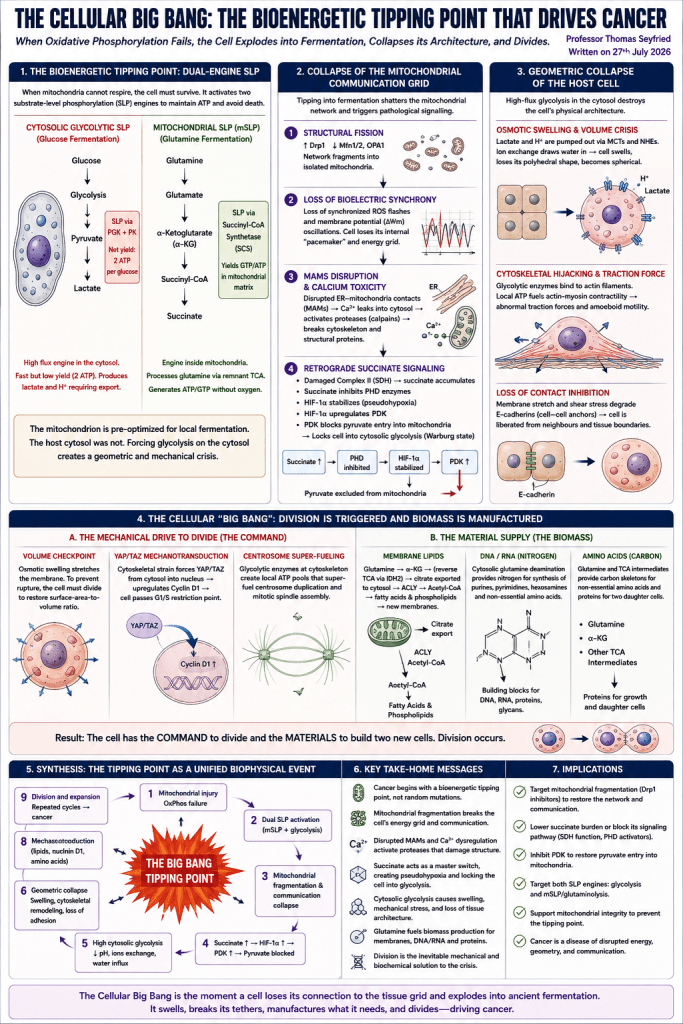
The hypothesis explored here calls these the two engines.
—
Why does where the energy is produced matter?
This is where the idea becomes particularly interesting.
A mitochondrion is a specialised compartment. It has evolved to handle enormous amounts of biochemical activity inside a very small space.
The cell’s general cytoplasm is different.
It was built around the assumption that the mitochondria would provide most of the cell’s energy efficiently.
If the cytoplasm suddenly has to process huge quantities of glucose just to keep the cell alive, the argument is that this isn’t simply a biochemical change.
It may become a physical problem.
Large amounts of glucose have to enter the cell. Glycolytic reactions have to run at very high rates. Lactate, hydrogen ions and other products have to be removed. Ion gradients have to be maintained.
The cell may consequently change its shape, its membrane, its cytoskeleton and its interactions with neighbouring cells.
This leads to the central idea:
Perhaps the location of fermentation matters just as much as the fact that fermentation is occurring.
If much of the abnormal energy production can remain compartmentalised inside abundant mitochondria, the cell may remain relatively organised.
If the energetic burden is pushed increasingly into the cytoplasm, the entire physical structure of the cell may be affected.
—
The mitochondria themselves may change
Healthy mitochondria often form interconnected networks within cells.
Cancer cells, however, can show major changes in mitochondrial shape and organisation. Mitochondria can become smaller, fragmented and less interconnected.
Proteins involved in mitochondrial fission and fusion, including Drp1, Mfn1/Mfn2 and OPA1, help regulate this structure.
A proposed sequence is:
Mitochondrial dysfunction
↓
Mitochondrial fragmentation
↓
Loss of normal communication between mitochondria
↓
Greater dependence on alternative energy pathways
↓
Increasing reliance on cytosolic glycolysis
The important point is that this is a hypothesis about causation, not an established universal sequence for every cancer.
But it provides a very interesting framework for investigation.
—
The succinate connection
There is another fascinating piece of the puzzle: succinate.
When mitochondrial metabolism becomes abnormal, succinate can accumulate.
Succinate is not simply a waste product. It can act as a signalling molecule.
One of its important effects is to inhibit enzymes called prolyl hydroxylases (PHDs).
These enzymes normally help regulate a protein called HIF-1α.
When HIF-1α becomes stabilised, the cell can behave as though it is experiencing low oxygen — even when oxygen is actually present.
This is sometimes called pseudohypoxia.
HIF-1α can then promote changes that favour glycolysis and other adaptations associated with cancer metabolism.
One pathway involves PDK, which inhibits pyruvate dehydrogenase.
That makes it harder for glucose-derived pyruvate to enter mitochondrial oxidative metabolism.
In simplified terms:
Mitochondrial dysfunction
→ succinate accumulation
→ PHD inhibition
→ HIF-1α stabilisation
→ PDK increases
→ less pyruvate entering mitochondrial oxidation
→ greater reliance on glycolysis
This potentially creates a self-reinforcing metabolic loop.
—
But the cell isn’t just changing its chemistry
This is where the Cellular Big Bang hypothesis becomes different from simply saying that cancer cells have altered metabolism.
The proposal is that the metabolic changes begin to affect the physical structure of the cell.
High glycolytic activity produces large amounts of lactate and hydrogen ions.
The cell has to export these products, using transport systems such as monocarboxylate transporters.
Changes in ion movement can influence water movement and cell volume.
At the same time, glycolytic enzymes can associate with components of the cytoskeleton, creating localised areas of ATP production.
The cytoskeleton is the cell’s internal scaffolding. It also controls how the cell changes shape and interacts mechanically with its surroundings.
So abnormal metabolism can potentially become abnormal cell mechanics.
—
From a well-behaved cell to a moving cell
Healthy cells normally know where they belong.
They attach to neighbouring cells and to the extracellular matrix around them.
They respond to mechanical signals from their environment.
One important component of this system is E-cadherin, which helps neighbouring epithelial cells stick together.
Cancer cells frequently lose normal cell-cell adhesion and become much more capable of moving through surrounding tissue.
Mechanical signalling is also connected to pathways involving YAP and TAZ.
These proteins respond to changes in cellular tension and the physical environment and can influence genes involved in growth and proliferation.
So the proposed chain is:
Metabolic disturbance
→ physical changes in the cell
→ cytoskeletal tension and altered adhesion
→ mechanical signalling
→ changes in growth and proliferation
This is an important concept because it means that the cell may not simply be receiving a genetic instruction saying:
“Divide.”
Its altered physical environment may itself be contributing to the instruction.
—
Why would the cell divide?
Here the hypothesis becomes particularly unconventional.
Imagine a cell that is becoming metabolically inefficient, swollen and mechanically stressed.
It needs enormous quantities of nutrients to keep producing energy and maintaining itself.
At the same time, it needs to manufacture new membranes, proteins, DNA and other components if it is going to divide.
The proposed solution is:
Divide.
A larger cell becomes two smaller cells.
Those cells can then continue the same process.
And if the metabolic problem remains, they divide again.
This provides a possible explanation for the apparently relentless expansion of a tumour:
metabolic crisis → adaptation → physical stress → proliferation → more cells → greater metabolic demand → further proliferation.
That is the proposed Cellular Big Bang.
—
Where does the material for all these new cells come from?
This is where glutamine becomes particularly important.
A dividing cell needs far more than ATP.
It needs raw materials.
It needs:
– amino acids for proteins
– carbon skeletons for new cellular structures
– nitrogen for DNA and RNA
– fatty acids and phospholipids for new membranes
– nucleotides for copying its genome.
Glutamine is extraordinarily useful because it can contribute both carbon and nitrogen to cellular metabolism.
Glutamine-derived carbon can feed metabolic pathways that ultimately contribute to lipid synthesis.
Its nitrogen can contribute to the production of nucleotides and other molecules.
So the proposed two-engine system has an interesting division of labour:
Cytosolic glucose fermentation
Provides rapid, local ATP and contributes to the physical/mechanical changes in the cell.
Mitochondrial glutamine metabolism
Provides ATP/GTP and supplies carbon and nitrogen needed to manufacture cellular material.
Together, they could potentially allow a damaged cell to survive, grow and divide despite impaired oxidative phosphorylation.
—
An intriguing clue: oncocytic tumours
One of the observations that makes this hypothesis particularly interesting involves oncocytic tumours.
Some tumours contain enormous numbers of mitochondria. These cells can become packed with mitochondria, giving them their characteristic appearance.
Renal oncocytomas and Hürthle-cell tumours are examples.
Some oncocytic tumours have mitochondrial abnormalities affecting respiratory-chain function, yet they can remain relatively contained and indolent.
Why?
One possible interpretation is that the enormous mitochondrial mass provides additional capacity for alternative mitochondrial metabolism, allowing the cell to remain metabolically abnormal without necessarily developing the same invasive behaviour seen in some other cancers.
That is consistent with the hypothesis, but it does not prove it.
An alternative explanation could be that these tumours possess other biological characteristics that prevent invasion.
That is precisely why the hypothesis needs experimental testing.
—
The opposite pattern
Now consider an aggressive tumour in which mitochondrial mass or function is substantially reduced.
The hypothesis predicts that the cell would increasingly depend upon cytosolic glycolysis.
The energetic burden moves out of the specialised mitochondrial compartment and into the general cytoplasm.
The proposed consequence is increasing:
– glucose consumption
– lactate production
– ion transport
– cytoskeletal activity
– mechanical stress
– loss of normal adhesion
– cellular movement
– proliferation.
If this were correct, mitochondrial abundance would not merely be an interesting feature of a tumour.
It could be part of the mechanism controlling its physical behaviour.
—
This gives us a testable prediction
The most exciting thing about this hypothesis is that it can be tested.
Take tumour cells with lots of mitochondria and compare them with closely related cells containing much less mitochondrial mass.
Then manipulate their metabolic pathways.
For example:
Block mitochondrial glutamine metabolism
Does the high-mitochondrial cell compensate by increasing glycolysis?
Does its shape change?
Does it become more mechanically active?
Does it generate greater traction against its surroundings?
Does it become more invasive?
And then perform the opposite experiment:
Reduce glycolytic dependence in an aggressive, low-mitochondrial cell.
Does its invasive behaviour decrease?
If changing the balance between mitochondrial and cytosolic SLP repeatedly changes the physical behaviour of the cells, that would provide much stronger evidence for this model.
—
The important caveat
This is where scientific caution matters.
Many of the individual observations in this model are well established:
Cancer metabolism changes.
The Warburg effect exists.
Cancer cells can use large quantities of glutamine.
Succinate can act as an oncometabolite.
HIF-1α can promote glycolytic metabolism.
Mitochondrial dynamics change in cancer.
Mechanical signalling can influence proliferation and invasion.
What has not been established is that these observations are all pieces of one universal causal sequence beginning with mitochondrial respiratory failure.
Cancer is enormously diverse.
Different cancers can have different genetic alterations, different mitochondrial states, different nutrient dependencies and different ways of generating energy.
So the Cellular Big Bang should currently be regarded as a mechanistic hypothesis, not an established replacement for the conventional understanding of cancer.
—
A different picture of cancer
The conventional picture often looks something like this:
Mutation
→ abnormal signalling
→ uncontrolled growth
→ tumour
The Cellular Big Bang hypothesis proposes something more like:
Mitochondrial dysfunction
→ energy crisis
→ fermentation-based survival
→ mitochondrial fragmentation and metabolic signalling
→ cytosolic metabolic overload
→ changes in cell geometry and mechanics
→ loss of normal tissue constraints
→ proliferation and biomass production
→ repeated division
→ tumour progression
And mutations may occur throughout this process rather than necessarily being the initial event.
That is the central idea.
Cancer, in this model, is not simply a cell that has acquired the wrong genetic instructions.
It is a cell that has lost its normal energetic relationship with its surroundings — and has found a primitive but remarkably effective way to survive.
It ferments.
It remodels itself.
It acquires the materials needed to grow.
It divides.
And if the underlying metabolic problem persists, the process can continue.
That is the “Cellular Big Bang”: a proposed moment when a cell crosses an energetic and physical tipping point, after which metabolism, structure, signalling and proliferation become locked into a self-reinforcing cycle.
Discover more from Feel Good Counselling
Subscribe to get the latest posts sent to your email.
